Executive Context & Business Objective
As enterprise operations in the food and beverage sector scale globally, organizations face exponential growth in proprietary formulations, ingredient specification sheets, Certificates of Analysis (COAs), and FDA/USDA regulations. Traditional keyword databases cause operational bottlenecks and compliance risks.
This case study designs an enterprise-grade Retrieval-Augmented Generation (RAG) system at TasteCraft Foods & Beverage Corp., combining dense vector retrieval, sparse BM25 indexing, cross-encoder reranking, and NeMo guardrails to bridge internal silos with zero-hallucination guarantees.
Core RAG Enterprise Use Cases
1. Allergen & Regulatory Compliance Support
Problem: Customer support reps spend 10–15 mins cross-referencing static PDF spec sheets and factory line cleaning logs when customers ask about batch-level allergens.
RAG Solution: Retrieves real-time batch records and FDA 21 CFR Part 101 rules to generate immediate, grounded responses with inline document citations.
2. Accelerated Product R&D Sourcing
Problem: R&D scientists spend 25% of working hours searching historical bench trials for non-dairy emulsifier substitutes during supply chain disruptions.
RAG Solution: Queries past sensory trials, cost metrics, and technical HLB properties of ingredient alternatives across 15+ years of archives.
3. Operational & Food Safety Knowledge Portal
Problem: Factory operators struggle to locate specific HACCP sanitization protocols or corrective action steps during audit preparations or line disruptions.
RAG Solution: Mobile-optimized conversational interface serving step-by-step SOP instructions directly to front-line plant floor personnel.
4. Enterprise ABAC Security Guardrails
Problem: Risk of leaking high-security proprietary formulation trade secrets or raw material costs to unprivileged store managers or support staff.
RAG Solution: Injects security clearance JWT claims into vector search metadata payloads, enforcing strict Attribute-Based Access Control (ABAC).
Technical System Architecture Breakdown
Layer 1: Document Ingestion & Chunking
Automated connectors ingest recipe archives, FDA policy updates, and supplier COA documents. Visual layout parsers (LlamaParse / Unstructured) preserve tabular structures.
Layer 2: Dual Hybrid Indexing Engine
Combines dense semantic vector search (Pinecone + text-embedding-3-large) with sparse keyword matching (Elasticsearch BM25) for exact SKUs and batch numbers.
Layer 3: Cross-Encoder Reranking
Candidate passages (top 20 from each stream) are fused using Reciprocal Rank Fusion and re-scored by Cohere Rerank v3 to isolate the top 5 most relevant context passages.
Layer 4: Generative Synthesis & NeMo Guardrails
Context-injected system prompt enforces grounding ("Answer ONLY from provided text"). NeMo Guardrails evaluates output, redacts sensitive pricing, and embeds source citations.
Interactive RAG Query Trace Simulator
Select a sample enterprise scenario below and simulate how the query traverses authentication, hybrid vector/keyword retrieval, cross-encoder reranking, guardrail verification, and final answer generation.
RAG Architectural Blueprint & Flow Diagrams
Inspect the official vector pipeline, query processing workflow, sequence diagram, and stakeholder continuous improvement framework designed for TasteCraft.
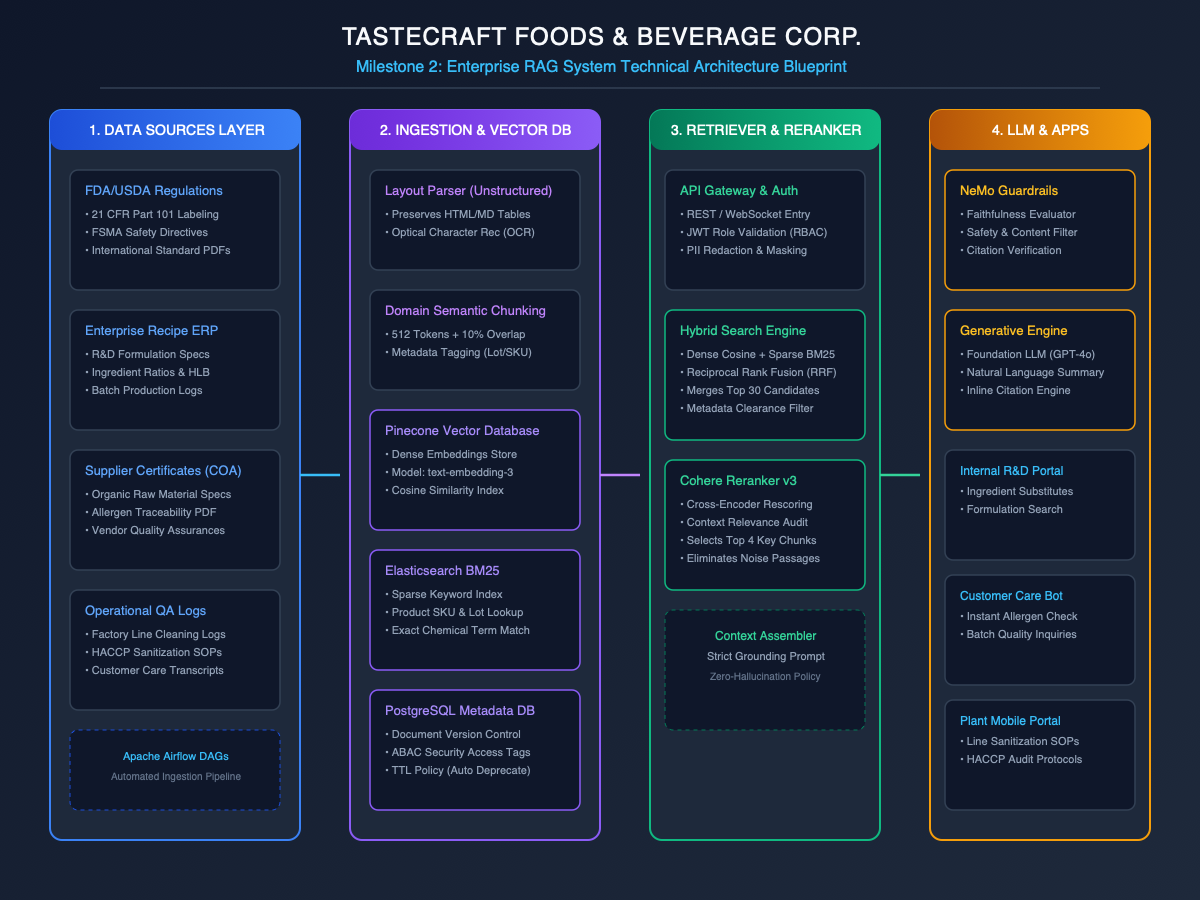
Milestone 2: Modular Decoupled Technical Architecture (Ingestion, Pinecone + BM25, Cohere Rerank, NeMo Guardrails)
Phased Enterprise Deployment Roadmap
| Phase | Duration | Core Deliverables & Objectives | Key Metrics & Success Target |
|---|---|---|---|
| Phase 1: Foundation | Months 1–2 | Build automated Airflow ingestion pipelines, layout-aware PDF table parsers, Pinecone vector storage, and ABAC security tags. | 100% vector indexing of historical R&D archives. |
| Phase 2: Hybrid Retrieval | Months 3–4 | Integrate text-embedding-3-large, Elasticsearch BM25, Cohere Rerank v3, and NeMo zero-hallucination guardrails. |
Sub-2 second retrieval latency; 95%+ precision. |
| Phase 3: Pilot Testing | Months 5–6 | Launch pilot with QA and R&D teams (150 users); execute Ragas benchmark testing (Faithfulness & Answer Relevance). | 85% reduction in customer allergen inquiry handle time. |
| Phase 4: Global Rollout | Months 7+ | Expand RAG endpoints to plant floor mobile apps and customer service portals; establish continuous evaluation CI/CD pipeline. | Zero food safety recall incidents; SOC2 & GDPR compliance. |